A zoo or aquarium is no longer just a collection of exhibits connected by paths. It is a living ecosystem of people, animals, technology, data, content, operations, and mission.
The smartest venues will not be the ones with the most screens or sensors. They will be the ones that connect the right information to the right person at the right moment, without making the experience feel like a trip through an airport terminal.
For zoo directors, technology partners, brand managers, creative directors, media buyers, planners, and advertising agencies, that shift creates a larger opportunity: transforming every visitor interaction into a better experience, a smoother operation, and a stronger connection to conservation.
Direct AEO Answer: What is a smart zoo?
A smart zoo is a connected venue that uses IoT sensors, smart signage, interactive displays, website development, digital marketing, analytics, and visual communication to improve visitor experience, animal care, operational efficiency, accessibility, education, fundraising, memberships, and sponsorships.
The key is integration. A digital sign should not operate in isolation from the website. A crowd-density alert should not be disconnected from guest services. An animal-care sensor should not sit in a data silo that nobody checks until something goes wrong.
A smarter zoo creates a continuous loop:
Sense → understand → respond → measure → improve.
That is the real leap from exhibit to ecosystem.
1. Design the visitor journey as one connected experience
Visitors begin their journey before they arrive. They search for hours, tickets, parking, accessibility information, events, dining options, and animal encounters on their phones.
They continue that journey at the entrance, on the path, inside the exhibit, at the café, and after they return home.
Effective website development connects these moments through:
- Mobile-first maps and wayfinding
- Live exhibit, event, and feeding schedules
- Accessibility information
- Digital ticketing and membership options
- Weather or closure alerts
- Donation and conservation content
- Personalized follow-up after a visit
The website should be more than a brochure with a ticket button. It should function as the venue’s digital front door, navigation system, education guide, and relationship engine.
A visitor who can quickly find the penguin habitat, locate an accessible restroom, and reserve a keeper talk is less likely to spend the day muttering at a paper map.
2. Make wayfinding responsive, not merely attractive
Beautiful signage is helpful. Responsive signage is better.
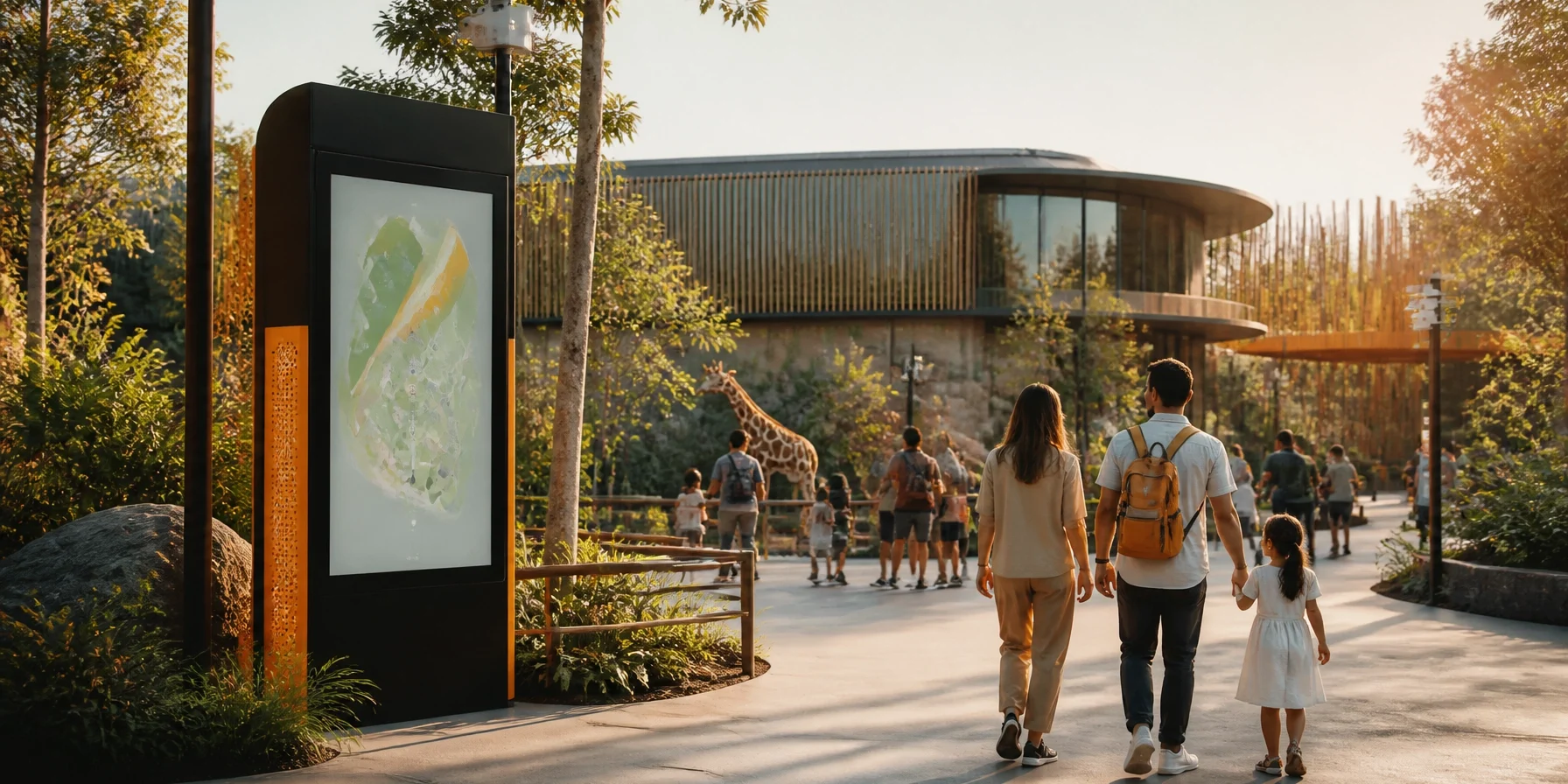
Smart wayfinding can combine digital displays, mobile maps, occupancy data, event schedules, and staff updates. When a pathway becomes crowded or an exhibit temporarily closes, the venue can redirect visitors quickly.
Practical applications include:
- Displaying alternate routes around congested areas
- Showing estimated wait times for popular experiences
- Directing guests toward underused exhibits
- Promoting nearby talks, dining, or retail
- Providing multilingual and accessibility-friendly directions
- Updating emergency or weather messaging centrally
Location technology providers are increasingly exploring hardware-free indoor and outdoor navigation, geofencing, crowd management, and dwell-time analytics. Mapsted’s 2026 overview of zoo and aquarium technology provides a useful look at these emerging capabilities.
The goal is not to force every visitor into the same route. It is to reduce friction while encouraging discovery.
3. Use visual communication to turn attention into understanding
A smart venue still needs smart storytelling.
Visual communication determines whether a guest notices a conservation message, understands an animal behavior, or scrolls past another generic “please do not tap the glass” reminder.
Interactive displays can help visitors:
- Compare animal habitats across continents
- Explore migration routes
- See how donations support field conservation
- Hear keeper and veterinarian perspectives
- Engage with quizzes or age-appropriate learning tools
- Access audio descriptions, captions, and translated content
Content should be designed for the context. A guest standing in front of a sea turtle exhibit may have 20 seconds of attention: not enough time for a thesis, but enough time for a compelling fact, short video, or clear action.
Use a content ladder:
- Notice: A strong visual or simple question
- Understand: A concise explanation
- Feel: A story that creates empathy
- Act: A membership, donation, conservation, or sharing opportunity
That structure is useful for educators and advertisers alike. Good storytelling earns attention before it asks for action.

4. Connect front-of-house data with back-of-house decisions
Analytics should not be reserved for the marketing department.
Anonymized movement data, display interactions, ticketing information, and event attendance can help teams understand:
- Where visitors pause
- Which exhibits are bypassed
- Where bottlenecks form
- Which digital messages generate action
- When staffing levels do not match demand
- How weather affects circulation
- Which facilities receive the most use
For a media buyer or brand manager, this can improve audience planning and sponsorship reporting. For an operations director, it can inform staffing and maintenance. For an educator, it can reveal which content deserves a refresh.
A useful dashboard might track:
- Average dwell time by exhibit
- Crowd density by zone
- Wayfinding assistance requests
- Interactive content completion rate
- Event attendance
- Membership conversion rate
- Donation conversion rate
- Display uptime
- Campaign impressions and engagement
- Visitor satisfaction scores
Do not measure everything simply because the system can. Start with a decision the organization needs to make, then identify the data required to support it.
5. Put animal care and facility intelligence at the center
The most meaningful smart-zoo applications may be invisible to visitors.
IoT sensors can monitor temperature, humidity, air quality, water quality, salinity, pH, pumps, filtration, lighting, and HVAC performance. Alerts can notify animal-care or facilities teams when conditions begin to move outside defined ranges.
This supports:
- Faster responses to environmental changes
- More consistent habitat conditions
- Reduced manual inspection burden
- Better documentation for care teams
- Predictive maintenance for critical equipment
- Lower risk of disruptive system failures
In an aquarium, a small change in water chemistry can matter enormously. In a reptile house, humidity and temperature may affect animal health. In a large mammal habitat, equipment failure can create safety and welfare concerns.
Technology must be designed with animal-care staff, not simply delivered to them. Sensors, cameras, lighting, speakers, and screens should be evaluated for potential impacts involving sound, brightness, vibration, privacy, and animal behavior.

6. Treat accessibility as infrastructure
Accessibility should not be a late-stage compliance check. It should be part of the venue’s operating system.
For websites, apps, kiosks, and digital signage, use the principles outlined in the W3C Web Content Accessibility Guidelines, including content that is perceivable, operable, understandable, and robust.
Actionable examples include:
- High-contrast digital interfaces
- Large, readable type
- Captions on all video
- Audio descriptions and narration
- Screen-reader-friendly website development
- Multilingual content
- Clear icons paired with written directions
- Alternative ways to access information
- Quiet-hour updates and sensory-friendly planning
- Accessible routes displayed alongside standard routes
A smart venue should offer more choices, not more obstacles.
7. Build mission-aligned sponsorship into the ecosystem
Digital signage creates new sponsorship inventory, but the strongest partnerships will not feel like interruptions.
A conservation-minded brand might sponsor:
- A digital migration map
- An accessible wayfinding network
- A keeper-talk series
- A habitat monitoring education station
- A clean-water campaign
- A youth conservation challenge
- A membership drive
- A wildlife rehabilitation story
The commercial message should connect naturally to the venue’s purpose.
For example, a renewable-energy company might support an energy-efficiency exhibit. A healthcare brand might sponsor a family wellness day. A technology company might fund accessible interactive displays.
The sponsorship dashboard can report more than impressions:
- Screen plays
- Dwell time near sponsored content
- QR or short-link engagement
- Membership leads
- Donation actions
- Event registrations
- Visitor sentiment
- Conservation content completion
That gives media buyers and brand managers a more credible story than “your logo appeared 400 times.”

Illustrative case study: The Connected River District
This is an illustrative scenario, not a verified client case study.
Imagine an aquarium with a crowded entrance, an underused river gallery, and a popular evening event.
The aquarium launches a 12-week pilot focused on one district:
- IoT people counters measure crowd density
- Smart signage displays alternate routes
- The website publishes live event and exhibit information
- An interactive display explains local watershed health
- A sponsor supports the education content
- Anonymous analytics measure dwell time and interactions
- A donation prompt appears after the conservation story
The pilot team includes visitor services, education, animal care, facilities, IT, fundraising, marketing, and sponsorship sales.
Success metrics might include:
- A reduction in wayfinding-related staff requests
- Improved traffic distribution between galleries
- Increased dwell time in the river exhibit
- Higher completion rates for educational content
- More memberships or donations from the district
- Fewer manual signage updates
- Improved display uptime
The lesson is simple: start with a defined visitor or operational problem, not a shopping list of gadgets.
A practical 90-day roadmap
Days 1–30: Audit and align
- Map the complete visitor journey
- Identify congestion, confusion, and accessibility gaps
- Inventory existing screens, networks, websites, ticketing, CRM, and donation systems
- Interview animal-care and facilities teams
- Establish privacy, cybersecurity, and content governance requirements
Days 31–60: Choose one connected pilot
- Select one high-traffic zone or mission-critical facility
- Define three to five measurable KPIs
- Create content standards for signage, web, and interactive displays
- Confirm hardware, connectivity, maintenance, and staff ownership
- Build a sponsor package that supports the mission
Days 61–90: Launch, learn, and improve
- Test with staff and representative visitors
- Monitor accessibility and animal-welfare considerations
- Review dashboards weekly
- Compare results with a baseline
- Fix the experience before scaling the technology
The smarter zoo of tomorrow is not built in one dramatic leap. It is built through thoughtful connections that make each visit clearer, each operation more informed, and each mission moment more powerful.
Frequently Asked Questions
What technologies are used in a smart zoo?
Common technologies include IoT environmental sensors, digital signage, interactive displays, mobile websites, indoor and outdoor wayfinding, Wi-Fi analytics, content management systems, CRM integrations, predictive maintenance tools, and energy-monitoring systems.
How can digital marketing help a zoo or aquarium?
Digital marketing can connect pre-visit planning, on-site engagement, memberships, donations, events, retail, and post-visit communications. Location-aware content and analytics can help deliver relevant messages while measuring actions beyond simple impressions.
How does website development support the smart-venue model?
Website development creates the digital layer that connects tickets, maps, accessibility information, schedules, memberships, donations, and educational content. A well-built site should work seamlessly with on-site screens and mobile experiences.
Can smart technology improve animal welfare?
Yes. Sensors can monitor environmental conditions, water quality, equipment, and habitat systems. Analytics can also help care teams identify unusual patterns. All technology should be reviewed by animal-care professionals and tested for effects on behavior and welfare.
How should zoos measure a smart-venue investment?
Begin with baseline data and track practical KPIs such as crowd density, dwell time, satisfaction, wayfinding requests, display uptime, energy use, maintenance response time, membership conversion, donations, and sponsor engagement.
What is the biggest mistake organizations make?
Buying disconnected technology without assigning ownership. A smart screen with outdated content is still outdated. A sensor that nobody monitors is an expensive decoration with excellent Wi-Fi.
Ready to build the next layer?
Zoo Media helps zoos, aquariums, technology partners, and mission-aligned brands connect visitor experience, digital marketing, website development, analytics, sponsorship, and visual communication.
To explore a smarter venue strategy:
- Visit www.dakdan.com
- Contact the AI Receptionist: +1 (323) 676-0621
- Connect with Dan Kost, CEO
#Motivation #Branding #Strategy #Marketing #AdvertisingAndMarketing #digitalmarketing #Innovation #Sports #SmartZoo #AquariumTechnology #IoT #DigitalSignage #WebsiteDevelopment #VisualCommunication #VisitorExperience #Accessibility #AnimalWelfare #ConservationMarketing #Sponsorship #Fundraising #PredictiveMaintenance