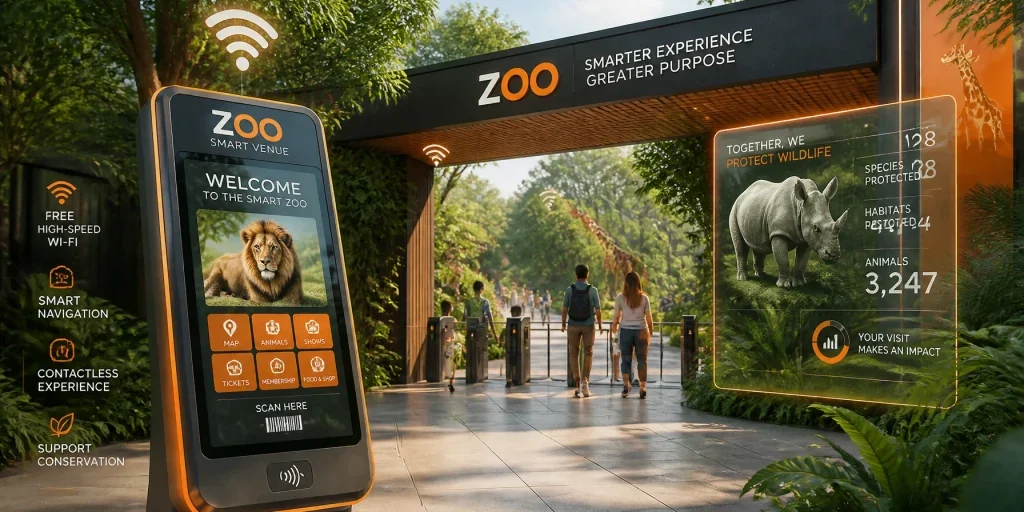
A modern zoo or aquarium is more than a collection of exhibits. It is a complex operating environment with animal habitats, mechanical systems, guest services, retail, food and beverage, education programs, memberships, events, and sponsorship inventory: all moving at once.
That complexity creates opportunity.
By combining IoT sensors, smart signage, interactive displays, connected websites, and real-time analytics, zoos and aquariums can become smart venues: places that use technology to improve the visitor experience while making daily operations more efficient and measurable.
A smart zoo venue connects technology, data, and visual communication to improve guest flow, staffing, maintenance, energy management, animal welfare, and revenue opportunities.
For directors, the business case is straightforward: smart technology should not be installed simply because it looks impressive. It should solve operational problems, create measurable value, and support the mission.
Why Operational Efficiency Is the Real Smart Venue Advantage
Visitors notice the screens, mobile maps, and interactive exhibits.
Staff notice everything behind the scenes.
A smart venue can help teams:
- Identify crowded areas before they become bottlenecks
- Redirect visitors with real-time digital signage
- Schedule staff according to actual visitor demand
- Monitor water quality, temperature, humidity, and equipment status
- Reduce manual updates to signs and schedules
- Predict maintenance issues before equipment fails
- Connect on-site behavior to memberships, donations, and digital marketing
- Build premium, measurable sponsorship packages
The result is not technology for technology’s sake. It is a more responsive operation that can do more with the same people, infrastructure, and budget.
1. IoT Creates a Nervous System for the Venue
IoT, or the Internet of Things, allows sensors and connected devices to collect and share information in real time.
In a zoo or aquarium, that information can support both animal care and facility operations.
Practical IoT applications include:
- Monitoring aquarium pH, salinity, oxygen, and temperature
- Tracking humidity and temperature in reptile, bird, and tropical habitats
- Measuring energy consumption across buildings and exhibit zones
- Monitoring pumps, filters, chillers, lighting, and HVAC systems
- Tracking visitor density in high-traffic areas
- Receiving alerts when equipment operates outside normal parameters
For animal care teams, early alerts can help prevent environmental conditions from drifting beyond safe ranges.
For facilities teams, sensor data can reveal when a pump or filtration system is beginning to behave abnormally. That creates an opportunity to schedule maintenance during planned downtime instead of reacting to an emergency on a busy Saturday.
A smart system does not replace experienced keepers, veterinarians, or engineers. It gives them better information sooner.
2. Smart Signage Reduces Confusion, Queues, and Staff Workload
Static signs have a place. But they are not very good at responding to changing conditions.
A printed sign cannot tell visitors that the penguin talk has moved, the main path is congested, or a popular exhibit currently has a 25-minute wait.
Networked smart signage can.

Connected screens can update across an entire campus from one content management system. That means operations teams can quickly publish:
- Revised animal talk schedules
- Temporary closures
- Safety and emergency messages
- Weather-related guidance
- Accessibility information
- Food, retail, and membership promotions
- Alternative routes around congestion
- Sponsor content connected to a specific exhibit or conservation initiative
This is where visual communication becomes an operational tool.
Clear, well-timed messages reduce the number of repetitive questions directed to front-line staff. They also help visitors feel more in control of their day, which can improve satisfaction even when something unexpected occurs.
The best signage does not shout for attention. It provides the right information at the right moment.
3. Interactive Displays Turn Engagement Into Action
Interactive kiosks and displays can do more than entertain children while parents check the map.
They can support education, transactions, data collection, and revenue.
Visitors might use an interactive display to:
- Explore an animal’s habitat and conservation status
- Watch keeper demonstrations or behind-the-scenes footage
- Find accessible routes, restrooms, dining, or exhibits
- Renew a membership
- Make a conservation donation
- Purchase an animal encounter or special experience
- Participate in a digital conservation challenge
- Access multilingual content

For operations teams, self-service touchpoints can reduce pressure on ticket counters and guest services desks.
For education teams, interactive experiences make it easier to refresh content without redesigning and reprinting physical panels.
For brand managers and sponsors, these displays create a more meaningful environment for brand integration. A conservation partner can support an interactive coral reef experience, for example, rather than simply placing a logo on a banner.
That is a stronger story for the visitor: and a stronger performance narrative for the sponsor.
4. Data Helps Directors Staff the Venue More Intelligently
Many zoos still make staffing decisions based on historical patterns, instinct, or a spreadsheet built years ago.
Those tools are useful, but they do not show what is happening right now.
Visitor-flow analytics can provide anonymized insight into:
- Entry and exit patterns
- Exhibit dwell time
- Queue duration
- Underused paths
- High-demand amenities
- Retail and food service traffic
- Event attendance by location and time
- Visitor movement during weather changes
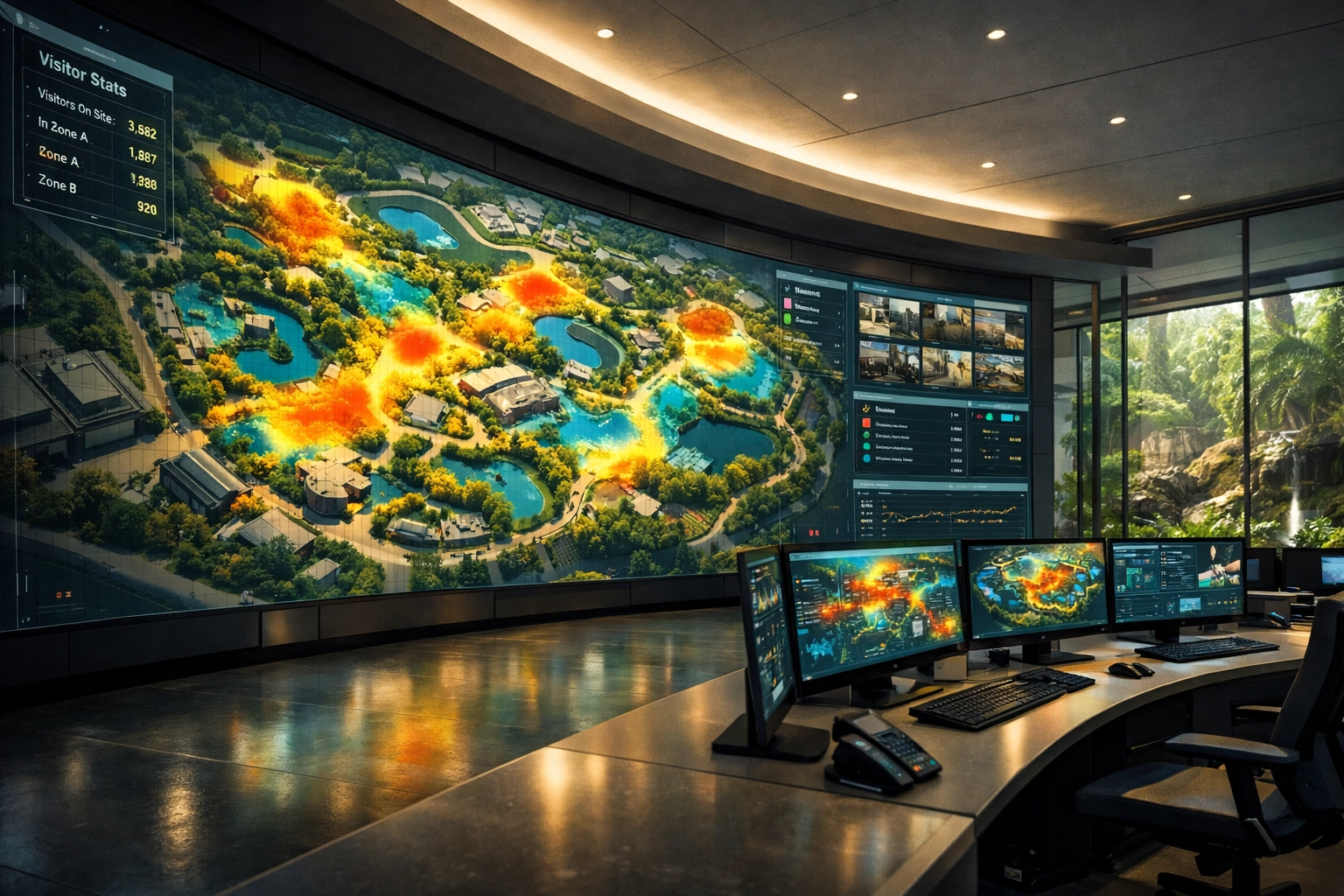
Suppose an aquarium sees a recurring bottleneck near a tunnel exhibit between 11:30 a.m. and 1:00 p.m. A dashboard may show that the issue is not simply attendance. It could be caused by a narrow viewing area, a nearby feeding presentation, or a concession stand that attracts visitors into the same corridor.
With that information, the team can test practical changes:
- Adjust presentation times
- Add temporary staff during the peak window
- Open an alternate route
- Move a promotional display
- Redirect visitors to another exhibit
- Update digital signage based on real-time density
The point is not to track people for the sake of tracking them. It is to understand how the venue functions and improve it responsibly, with privacy safeguards and transparent data practices.
An Illustrative Example: A Smarter Aquarium Zone
Consider a regional aquarium preparing for a major summer exhibit.
The aquarium begins with one smart zone rather than attempting a full-campus transformation. The zone includes:
- Crowd-density sensors
- A connected digital map
- Two interactive conservation displays
- Smart signage near the entrance and tunnel
- IoT monitoring for water and life-support systems
- A dashboard connecting visitor, operational, and sponsor metrics
During the first month, the team discovers three issues:
- Visitors are queuing near the tunnel because the feeding presentation and photo area overlap.
- Staff spend several hours each week manually updating printed schedules.
- The sponsor’s message is visible but receives little meaningful engagement.
The aquarium responds by shifting the presentation time, using smart signage to distribute traffic, and moving sponsor content into an interactive reef-conservation experience.
The operational scorecard tracks:
- Average queue time
- Staff hours spent on updates
- Exhibit dwell time
- Interactive engagement
- Donation conversions
- Sponsor impressions and interactions
- Equipment alerts and downtime
This is a real-world-style smart venue approach: begin with a measurable problem, pilot a focused solution, and scale based on results.
Energy and Predictive Maintenance: The Quiet ROI
Some of the most valuable smart venue improvements are invisible to visitors.
Connected systems can help facilities teams understand when energy is being used, where it is being wasted, and which equipment is under stress.
Smart controls may support:
- More precise HVAC scheduling
- Lighting adjustments based on occupancy
- Temperature and humidity monitoring
- Energy reporting by building or exhibit
- Early detection of unusual equipment behavior
- Planned maintenance instead of emergency repairs
In aquariums, this can be especially important because life-support systems often operate continuously. A small equipment issue can quickly become a major animal-care, guest-experience, and financial problem.
The business value comes from several directions:
- Lower avoidable energy consumption
- Fewer emergency service calls
- Reduced exhibit downtime
- Better asset life-cycle planning
- Stronger compliance and maintenance records
- Greater confidence in capital investment decisions
The technology pays for itself through a portfolio of improvements: not one magic metric.
Smart Venues Unlock Premium Sponsorship Inventory
For advertising agencies, media buyers, and creative directors, smart venues offer something traditional signage cannot: context, flexibility, and performance data.
A connected zoo or aquarium can package sponsorship around:
- Digital welcome walls
- Interactive conservation stations
- Smart benches and charging areas
- Wayfinding screens
- Species or habitat zones
- Mobile app content
- Educational video programming
- Seasonal events
- Membership and donation campaigns
- Website and post-visit content

A sponsor could own a “smart water” initiative across aquarium screens, educational kiosks, and digital content. A healthcare brand could support a family wellness trail. A technology company could underwrite an animal-care innovation exhibit.
The opportunity is to move from logo placement to mission-aligned participation.
With appropriate reporting, sponsors can receive data on:
- Screen plays
- Estimated reach
- Dwell time
- Interactions
- QR scans
- Content completion
- Donation or membership actions
- Campaign performance by zone
That makes the inventory more valuable to brand managers: and easier for agencies to defend in a media plan.
The Digital Layer Must Continue Beyond the Gates
A smart venue is not limited to what happens inside the park.
A strong website development strategy connects pre-visit planning, ticketing, membership, education, animal webcams, donations, and post-visit engagement.
The physical venue and digital channels should work together:
- The website prepares visitors for the day
- The mobile experience supports navigation on-site
- Interactive displays deepen engagement
- CRM and digital marketing encourage return visits
- Sponsor content continues across trusted digital channels
Zoo Media’s broader network, including ZooMedia.tv, ZooMedia.news, and ZooImagery.com, can help extend conservation storytelling and sponsor visibility beyond the gates.
A Practical Smart Venue Roadmap
Directors do not need to transform an entire campus overnight.
A practical sequence is:
-
Choose one operational problem.
Start with queues, wayfinding, energy, maintenance, or staff workload. -
Build the digital foundation.
Review connectivity, data systems, content management, cybersecurity, and device support. -
Pilot one high-value zone.
Use sensors, smart signage, and an interactive display where results can be measured. -
Define the scorecard.
Track costs, staff hours, queue times, satisfaction, engagement, donations, revenue, and uptime. -
Create a content and maintenance plan.
Smart hardware is only useful when content stays current and systems stay reliable. -
Package sponsorship after proving value.
Build media offerings around audience, context, engagement, and mission alignment.
The Bottom Line
Smart venue technology gives zoos and aquariums a clearer view of how their facilities operate.
IoT supports animal welfare, energy management, and predictive maintenance. Smart signage improves wayfinding and reduces pressure on staff. Interactive displays deepen education while supporting transactions and sponsorship. Data connects operational decisions to measurable business outcomes.
That combination is the operational edge.
Zoo Media helps zoos and aquariums connect technology, digital marketing, website development, and visual communication into a smarter visitor and business ecosystem.
Ready to Build a Smarter Venue?
Talk with Zoo Media about a practical smart venue roadmap for your zoo, aquarium, brand, or agency campaign.
- Explore Zoo Media: www.zoomedia.us
- Explore Zoo Media Network: ZooMediaNetwork.com
- Review smart venue resources: The Director’s Guide to Launching a Smart Venue
- Corporate partner: www.dakdan.com
- AI Receptionist: +1 (323) 676-0621
- CEO: Dan Kost, CEO
- Connect with DAKDAN Worldwide on LinkedIn
#Motivation #Branding #Strategy #Marketing #AdvertisingAndMarketing #digitalmarketing #Innovation #Sports #SmartVenues #ZooTechnology #AquariumTechnology #IoT #SmartSignage #InteractiveDisplays #VisitorExperience #OperationalEfficiency #PredictiveMaintenance #Sponsorship #VisualCommunication #WebsiteDevelopment #ConservationTechnology
Frequently Asked Questions
What is a smart venue in a zoo or aquarium?
A smart venue is a zoo or aquarium that connects IoT sensors, digital signage, interactive displays, websites, mobile experiences, and analytics to improve visitor experience, operational efficiency, animal welfare, and revenue performance.
How does smart technology improve zoo operations?
Smart technology helps teams monitor habitats and equipment, manage queues, improve wayfinding, allocate staff based on demand, reduce manual updates, optimize energy use, and identify maintenance issues before they become emergencies.
How can smart venues create better sponsorship opportunities?
Smart venues create premium sponsorship inventory through digital screens, interactive exhibits, smart benches, mobile content, conservation zones, and measurable visitor engagement. Sponsors can receive performance reporting instead of relying only on estimated foot traffic.