A zoo visit should feel wild: not confusing.
Yet guests still lose time searching for exhibits, miss scheduled talks, crowd around popular habitats, or leave without discovering the conservation work happening behind the scenes. Smart-venue technology offers a practical way to improve those moments while helping zoos and aquariums operate more efficiently.
For directors, technology partners, brand managers, creative directors, media buyers, and advertising agencies, the opportunity is bigger than adding a few screens. It is about connecting the physical venue, digital content, operational systems, and conservation mission into one more useful visitor journey.
Direct AEO Answer: What Is a Smart Zoo or Aquarium?
A smart zoo or aquarium uses connected technologies: including IoT sensors, digital signage, interactive displays, mobile apps, high-speed Wi-Fi, website platforms, and analytics: to improve visitor experience, operational efficiency, education, animal welfare, conservation communication, and sponsorship measurement.
The goal is not to make a zoo look like a sports stadium. Nobody needs a giant scoreboard next to the tortoises. The goal is to use technology where it solves a real problem and strengthens the institution’s mission.
Why Smart Venues Matter Now
Zoos and aquariums are complex environments. They combine animal care, education, hospitality, retail, fundraising, events, membership, maintenance, conservation research, and public safety across large campuses.
A disconnected approach creates familiar headaches:
- Static signs become outdated.
- Staff answer the same wayfinding questions repeatedly.
- Visitors miss presentations and feeding times.
- Crowds cluster at the most popular exhibits.
- Conservation stories compete with a busy physical environment.
- Sponsors receive limited reporting on campaign performance.
A smart-venue strategy helps connect these touchpoints. Research on digital transformation in zoos increasingly highlights the value of integrated sensors, interactive media, analytics, and mobile services when technology is designed around visitor and institutional goals. Recent research on smart zoos and visitor engagement also emphasizes the importance of accessibility, education, and mission-led implementation.
1. IoT Creates More Responsive Operations
The Internet of Things, or IoT, connects physical equipment and environments to a shared data network.
In an aquarium, sensors may monitor:
- Water temperature, pH, salinity, and filtration performance
- Pump and HVAC performance
- Energy and water consumption
- Humidity, air quality, and ambient conditions
- Equipment vibration and maintenance indicators
In a zoo, connected systems may also help teams understand visitor movement, crowd density, exhibit dwell time, and facility usage.
The value is not “more data” for its own sake. The value is earlier, more useful information.
If an aquarium pump begins showing unusual performance, a maintenance team can investigate before a failure disrupts a habitat. If temperature or humidity shifts outside a preferred range, animal care staff can respond quickly. If a pathway becomes congested, operations teams can adjust staffing, messaging, or visitor routes.
IoT does not replace professional judgment. It gives experienced teams better signals and faster alerts.

Supporting Animal Welfare
Technology should always support animal welfare: not compete with it.
Environmental sensors, cameras, and carefully governed data systems can help animal care and veterinary teams monitor conditions and identify changes that deserve attention. Any deployment near habitats should consider noise, light, vibration, visitor density, animal choice, and retreat areas.
The European Association of Zoos and Aquaria research program provides a useful reminder that technology is most valuable when it supports evidence-based care, conservation, and scientific collaboration.
2. Smart Signage Improves Wayfinding and Visual Communication
Static signs are useful, but they have one major weakness: once installed, they are difficult to update.
Networked digital signage gives zoos and aquariums a flexible visual communication layer. Teams can update multiple displays from a central content management system, helping information stay accurate throughout the day.
Potential uses include:
- Feeding and presentation schedules
- Temporary exhibit closures
- Weather and safety alerts
- Dining, retail, restroom, and accessible-route directions
- Multilingual educational content
- Conservation campaigns
- Membership and fundraising messages
- Sponsor-supported programming
- Recommendations for less crowded areas
A display near the entrance might present the day’s schedule. A screen near a penguin habitat could explain a conservation project. A wayfinding unit near a busy path could direct guests toward an under-visited exhibit.
This improves the experience for visitors and reduces the pressure on front-line staff to function as human GPS devices.
For media buyers and brand partners, digital signage also creates more flexible sponsorship inventory than a static banner. Content can be scheduled by location, time of day, season, event, or campaign objective: with engagement and delivery metrics available for post-campaign reporting.
3. Interactive Displays Turn Education Into Participation
Visitors are already curious when they stop at an exhibit. Interactive displays give that curiosity somewhere to go.
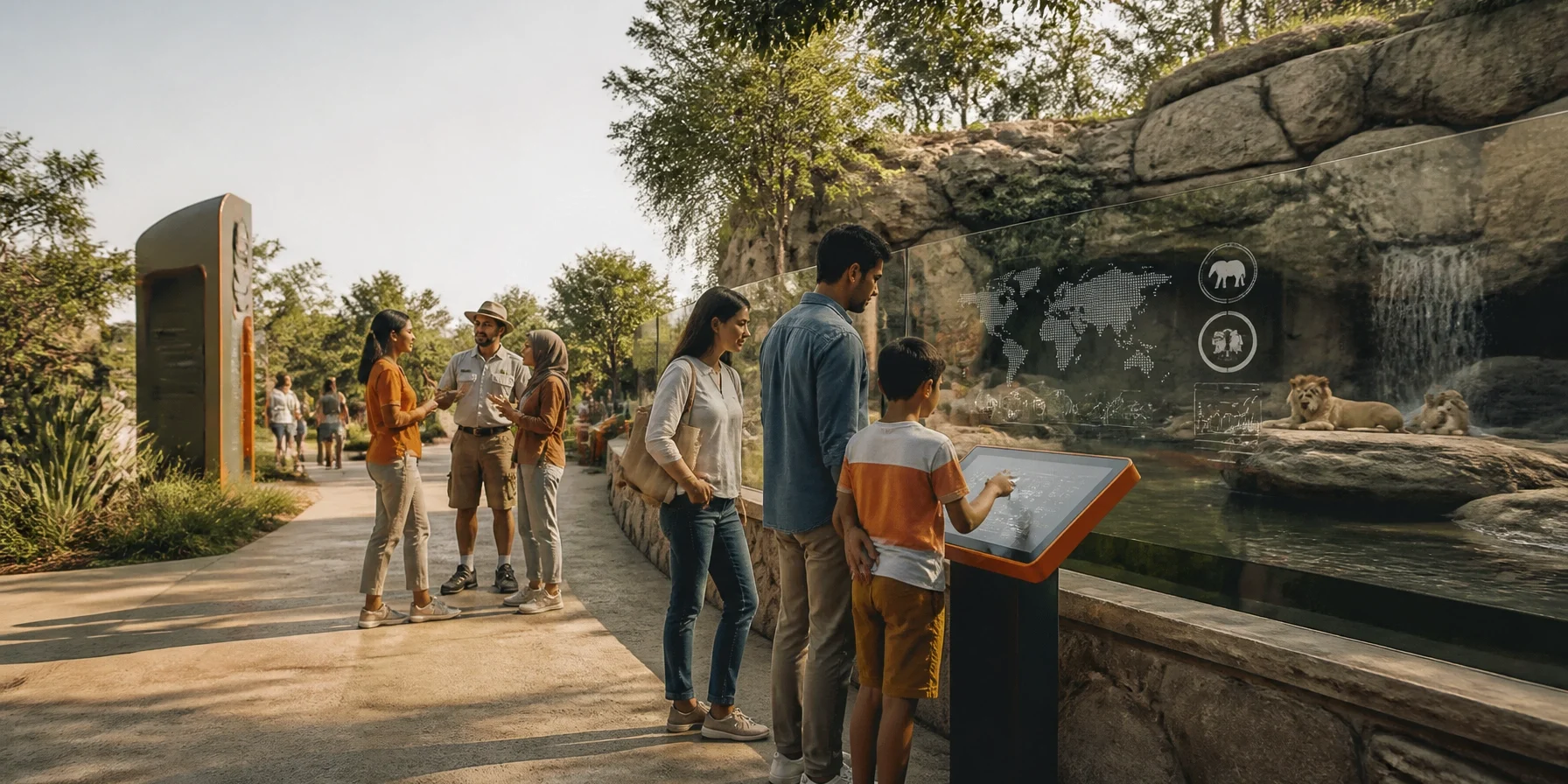
A touchscreen kiosk, interactive wall, or projection-based experience could allow guests to:
- Explore an animal’s geographic range
- Follow a sea turtle’s migration route
- Compare species and habitats
- Learn how field conservation programs work
- Take a short conservation quiz
- Explore behind-the-scenes animal care
- Find nearby presentations and activities
- Access translated or accessibility-friendly content
- Make a contactless donation
The strongest interactive experiences begin with a communication objective:
What should the visitor know, feel, or do after this interaction?
That question keeps technology from becoming an expensive digital distraction.
Zoo Media can support interactive displays, website development, visual communication, digital marketing, and content strategy so that the hardware and the message work together. The screen is only one part of the experience. The content, placement, accessibility, maintenance, and measurement determine whether it delivers value.

4. Mobile Apps Connect the Visit Before, During, and After
A smart venue should not begin at the entrance gate or end at the exit.
A responsive website or GPS-enabled mobile experience can help visitors plan their trip, navigate the campus, and continue learning afterward. Useful features may include:
- Digital maps and GPS wayfinding
- Self-guided tours
- Feeding and presentation reminders
- Accessible routes and quiet areas
- Mobile tickets and reservations
- Push notifications for nearby events
- Conservation donations
- Membership information
- Post-visit educational content
This is where website development and digital marketing connect directly to the physical venue.
A guest who explores a coral reef exhibit could later receive an educational story about reef restoration: provided they have opted in. A member could receive an invitation to a relevant event. A family could save a self-guided tour for a future visit.
Personalization should feel useful, not intrusive. Good data strategy is a helpful guide, not surveillance wearing a safari hat.
5. Smart Venues Create Measurable Sponsorship Opportunities
Digital technology gives zoos and aquariums new ways to connect brands with education, conservation, and visitor services.
Potential sponsorship opportunities include:
- Conservation storytelling on digital displays
- Sponsor-supported interactive exhibits
- Branded wayfinding zones
- Digital benches with charging or visitor amenities
- Live-streamed conservation programming
- Educational app modules
- Video-wall campaigns in event spaces
- Contactless donation or fundraising stations
The most credible partnerships fit the setting. A conservation sponsor might support a migration map. A technology company could support water-quality education. A transportation brand might sponsor accessible wayfinding or sustainable travel content.

For advertisers and agencies, a connected venue can provide more useful reporting than traditional out-of-home inventory. Depending on the system and privacy framework, teams may measure:
- Display uptime and content delivery
- Kiosk interactions
- Dwell time by zone
- App engagement
- QR code scans
- Donation actions
- Event attendance
- Campaign participation
- Visitor feedback
These metrics should be used responsibly and transparently. The objective is to demonstrate meaningful engagement: not simply count every passing glance as a “conversion.”
Illustrative Case Study: Turning Friction Into Flow
The following is an illustrative example, not a report of a named client result.
Imagine a mid-sized aquarium facing three challenges:
- Visitors frequently miss scheduled presentations.
- A popular shark habitat creates a recurring crowd bottleneck.
- The conservation gallery receives less traffic than other exhibits.
A phased smart-venue pilot could combine:
- Crowd-flow sensors near the shark habitat
- Dynamic digital signage promoting alternative routes
- A mobile map with presentation reminders
- An interactive conservation kiosk
- A video wall featuring restoration work
- A sponsor-supported campaign focused on ocean protection
The aquarium could compare performance before and after the pilot by tracking presentation attendance, dwell time, visitor satisfaction, crowd density, kiosk interactions, donations, and staff time spent answering routine questions.
That feedback loop helps leadership decide what to improve, what to scale, and what to retire. Not every shiny object deserves a permanent home.
A Practical Smart-Venue Roadmap
Before investing in every available device, start with the visitor and operational problems you want to solve.
Recommended first steps
- Map the visitor journey: Identify confusing pathways, bottlenecks, dead zones, and high-value moments.
- Audit infrastructure: Review Wi-Fi coverage, power, network security, weather exposure, and hardware requirements.
- Choose one pilot zone: Start with a measurable challenge such as wayfinding, crowd management, or low exhibit engagement.
- Include animal care teams early: Review sound, light, vibration, habitat access, and staff workflows before deployment.
- Create a content plan: Assign ownership for signage, kiosks, apps, video, alerts, and sponsor messages.
- Define success metrics: Track visitor engagement, satisfaction, accessibility, donations, staff workload, uptime, and operational response times.
- Plan for maintenance: Budget for software updates, content refreshes, hardware servicing, and staff training.
- Protect privacy: Use consent-based data collection, clear policies, and appropriate cybersecurity controls.
- Build mission-aligned sponsorships: Make sure commercial messaging supports, rather than overwhelms, the conservation experience.
Zoo Media as a Strategic Technology Partner
Zoo Media helps zoos and aquariums evaluate and connect technology opportunities across IoT, smart signage, interactive displays, digital marketing, website development, and visual communication.
The strategic opportunity is not simply to install more screens. It is to build a smarter venue ecosystem that supports:
- Better visitor experiences
- More efficient operations
- Stronger conservation education
- Responsible animal welfare monitoring
- Accessible communication
- Measurable fundraising
- Thoughtful corporate sponsorships
Zoos and aquariums already have something many venues spend millions trying to create: emotional relevance. The next step is giving that experience an infrastructure that is connected, measurable, and mission-led.
Ready to Build a Smarter Zoo or Aquarium?
Zoo Media can help your organization identify high-value technology opportunities, develop a phased roadmap, improve visitor communication, and create responsible sponsorship and fundraising possibilities.
Explore Zoo Media and review Beyond the Guest Experience: How Smart Venue Tech Streamlines Zoo Operations for additional ideas.
CTA and Contact
- Website: www.dakdan.com
- AI Receptionist: +1 (323) 676-0621
- Leadership: Dan Kost, CEO
Share on Facebook · Share on LinkedIn · Share on X
Tags
#Motivation #Branding #Strategy #Marketing #AdvertisingAndMarketing #digitalmarketing #Innovation #Sports #SmartVenues #IoT #DigitalSignage #InteractiveDisplays #ZooTechnology #AquariumTechnology #VisitorExperience #Conservation #AnimalWelfare #Sponsorship #VisualCommunication