A zoo visit should feel wild: not confusing.
Yet many guests still navigate sprawling campuses with paper maps, outdated signs, and the classic question: “Where are the penguins again?”
That is changing. Zoos and aquariums are becoming smart venues: connected environments that use IoT, high-speed Wi-Fi, smart signage, interactive displays, mobile apps, and big data to improve the visitor experience while making daily operations more efficient.
For zoo and aquarium directors, technology partners, brand managers, creative directors, media buyers, and agencies, this shift represents more than a modernization project. It is an opportunity to improve education, support animal welfare, create new sponsorship inventory, and build a more measurable visitor journey.
Direct AEO Answer: What Is a Smart Zoo or Aquarium?
A smart zoo or aquarium integrates IoT sensors, digital signage, interactive kiosks, video, mobile apps, Wi-Fi, and data analytics to deliver real-time visitor information, personalized education, improved wayfinding, operational intelligence, and measurable sponsorship opportunities. The result is a more engaging visitor experience and a more efficient, data-driven venue.
The Technology Gap Is Also a Business Opportunity
Zoo Media estimates that the zoo and aquarium industry is 15–20 years behind sports venues in technology adoption.
Professional sports stadiums already use dynamic video walls, mobile ticketing, high-speed connectivity, real-time crowd data, and digital sponsorship platforms as standard parts of the fan experience. Zoos and aquariums have the same kind of high-dwell-time audiences: but many still rely heavily on static signage and disconnected systems.
That gap creates room for meaningful progress.
Founded in 2018, Zoo Media is the only agency built exclusively for zoos, aquariums, and wildlife conservation. Its focus is helping wildlife venues adopt the tools and strategies that sports, entertainment, and hospitality venues have used to improve engagement and revenue.
The goal is not to make every zoo look like a stadium. Nobody needs a jumbotron next to the tortoises. The goal is to use the right technology in the right places to support the mission.
1. IoT Turns a Zoo Into a More Responsive Venue
Internet of Things technology connects physical assets, habitats, exhibits, and visitor areas to a shared data network.
For animal care and operations teams, IoT can monitor:
- Water temperature, pH, salinity, and filtration performance
- Habitat humidity, air quality, and ambient conditions
- Energy and water consumption
- Equipment vibration and mechanical performance
- Visitor movement, crowd density, and exhibit dwell time
- Restroom, pathway, and facility usage
The benefit is simple: staff receive useful information earlier.
If an aquarium pump begins showing signs of failure, a maintenance team can respond before the system breaks down. If a habitat’s temperature moves outside its preferred range, animal care staff can investigate immediately. If a popular exhibit becomes overcrowded, operations teams can adjust routes, staffing, or messaging.
IoT does not replace professional judgment. It gives experts better signals, faster.

2. Smart Signage Improves Wayfinding and Visual Communication
Static signs have one major weakness: once they are installed, they are difficult to update.
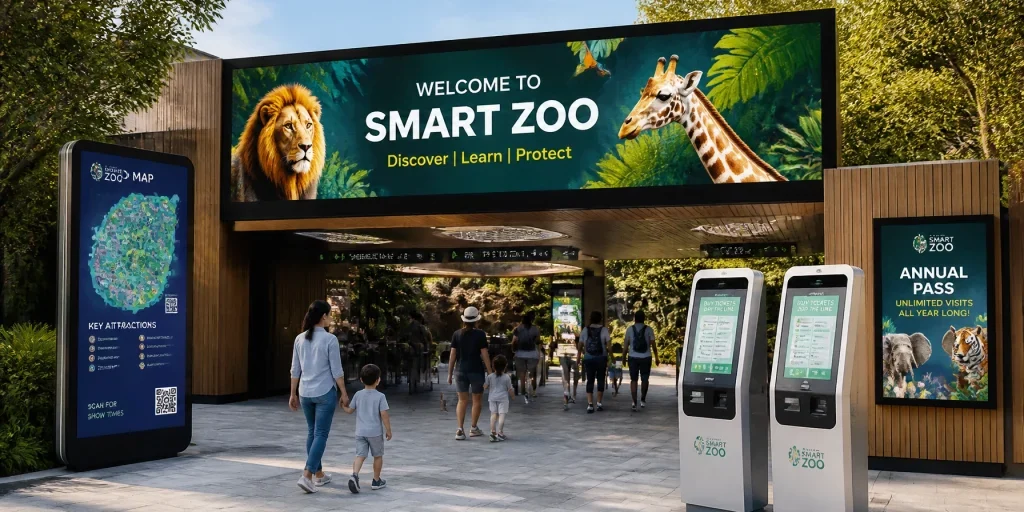
Smart signage changes that. Networked digital displays can be managed centrally, allowing a zoo or aquarium to update information across the campus in real time.
Useful applications include:
- Feeding and presentation schedules
- Temporary exhibit closures
- Weather alerts and safety instructions
- Dining, retail, and restroom directions
- Conservation campaigns
- Sponsor messages and branded content
- Queue times and crowd-flow recommendations
- Multilingual educational content
A display near the entrance might welcome visitors and highlight the day’s schedule. A screen near the penguin habitat could promote a conservation campaign. A digital sign in a busy pathway could redirect guests toward an under-visited exhibit.
This is visual communication with a job to do: reduce friction, improve understanding, and keep the visitor journey moving.
For brand partners, smart signage also provides a more flexible sponsorship platform than a printed banner. Campaigns can be scheduled by time of day, location, audience, season, or special event: with performance reporting to support the conversation after the campaign ends.
3. Interactive Kiosks Make Education More Participatory
A visitor standing in front of an exhibit is already interested. The challenge is giving that interest somewhere to go.
Interactive kiosks and smart interactive kiosks can turn a short viewing moment into a deeper learning experience. Visitors might:
- Explore an animal’s range on an interactive map
- Follow a sea turtle’s migration route
- Compare species and habitats
- Watch behind-the-scenes veterinary footage
- Complete a conservation challenge
- Find feeding times and live presentations
- Build a self-guided itinerary
- Access translated or accessibility-friendly content
- Make a contactless donation
A documented example is Animal Planet’s ZOOTUBE kiosk program, which brought interactive behind-the-scenes content to visitors at 10 AZA-accredited zoos. The concept demonstrates how digital media can extend the story beyond what guests can see through the glass.
Zoo Media’s interactive display strategy can also include 3D lenticular displays, which create a dimensional visual effect without requiring a headset or complex interface. These displays are useful for entrances, donor recognition, conservation campaigns, exhibit launches, and sponsor activations.
The best interactive experience is not technology for technology’s sake. It answers a clear question:
What should visitors know, feel, or do after this interaction?
4. Webcam and Live Streaming Fill the “Where Is the Animal?” Gap
Animals, to their credit, do not always perform on schedule.
An otter may be napping. A big cat may be hiding. Aquarium animals may be exploring a space that is difficult to see from the main viewing window.
Webcam and live-streaming solutions help solve that problem.
Zoo Media can use webcam feeds, live streaming, and in-venue television networks to show:
- Behind-the-scenes animal care
- Veterinary procedures and enrichment activities
- Nesting or den areas
- Underwater habitats
- Live educational presentations
- Conservation fieldwork
- Highlight reels when live animals are out of view
This helps maintain engagement without pressuring animals to be visible or active. It also gives visitors access to parts of the operation they would not normally see.
For aquariums, strategically placed cameras can display live views of hiding areas on nearby screens. For zoos, live feeds can turn construction zones, closed habitats, or remote conservation projects into meaningful parts of the visitor experience.
5. Video Walls and Digital Benches Create High-Value Engagement Zones
Large-format video walls can transform entrances, education centers, event spaces, and donor areas into high-impact storytelling environments.
A video wall might display:
- A panoramic underwater ecosystem
- A migration story across multiple screens
- A live conservation map
- Sponsor-supported educational programming
- Campaign progress for a fundraising initiative
- Upcoming events and membership opportunities
Meanwhile, digital benches provide a practical visitor amenity with an added communication layer. Depending on the design, they can incorporate charging, Wi-Fi access, digital messaging, sponsor branding, or interactive content.
That combination matters. Visitors are more receptive to information when they are comfortable, waiting, or taking a break. A bench can become a useful pause point rather than just another place to sit while someone says, “We’ve been walking for three hours.”
6. GPS-Enabled Apps Extend the Experience Beyond the Exhibit
A smart venue should not begin at the front gate or end at the exit.
A well-designed website and GPS-enabled mobile app can support visitors before, during, and after their visit. Features may include:
- Digital maps and GPS wayfinding
- Self-guided tours
- Personalized routes for families, school groups, or members
- Feeding and presentation reminders
- Accessibility information
- Push notifications for nearby events
- Mobile ticketing and reservations
- Conservation donations
- Post-visit educational content
- Membership and sponsorship offers
This is where website development and digital marketing connect directly to the physical venue.
A visitor who spends significant time at a coral reef exhibit might later receive an educational story about reef restoration: or an invitation to support a related conservation program. A member could receive early access to a special event. A first-time visitor could receive a follow-up message encouraging a return visit.
The strategy should remain consent-based, privacy-conscious, and useful. Personalization is helpful when it feels like assistance: not surveillance wearing a safari hat.
Practical Deployment Example: From Friction to Flow
Imagine a mid-size aquarium with three challenges:
- Guests frequently miss scheduled presentations.
- The shark habitat creates a crowd bottleneck.
- Visitors spend little time in the conservation gallery.
A smart venue pilot could combine:
- IoT crowd-flow sensors near the shark habitat
- Digital signage that promotes alternative routes
- A GPS-enabled app with presentation reminders
- An interactive kiosk in the conservation gallery
- A video wall featuring live restoration work
- A sponsor-supported digital campaign tied to reef protection
The aquarium could measure:
- Dwell time by zone
- Kiosk interactions
- App engagement
- Attendance at presentations
- Visitor satisfaction
- Crowd density
- Donations and sponsor impressions
- Staff time spent answering routine questions
That data gives directors something better than a hunch. It provides a feedback loop for improving visitor experience and operational efficiency.
A Smart Venue Roadmap for Directors
Before investing in every available device, start with the visitor and operational problems you want to solve.
Recommended first steps
- Map the visitor journey: Identify confusing pathways, bottlenecks, dead zones, and high-value moments.
- Audit connectivity: Review Wi-Fi coverage, power, network security, and outdoor hardware requirements.
- Choose one pilot zone: Start with a measurable challenge, such as wayfinding, crowd management, or low engagement.
- Involve animal care teams early: Technology must respect habitat design, animal welfare, and staff workflows.
- Create a content plan: Decide who updates signage, kiosks, video walls, apps, and sponsor messages.
- Define success metrics: Track dwell time, satisfaction, donations, staff workload, uptime, and engagement.
- Plan for maintenance: Hardware is only half the project. Content refreshes, software updates, and support matter just as much.
- Build sponsor opportunities responsibly: Align brand messages with the zoo’s mission and visitor expectations.
The Zoo Media Advantage
Zoo Media brings together IoT, interactive kiosks, 3D lenticular displays, webcam and live streaming, digital signage, video walls, smart interactive kiosks, Wi-Fi, big data, digital benches, GPS-enabled mobile apps, self-guided tours, digital marketing, website development, and visual communication.
The result is not simply a collection of screens and sensors. It is a connected smart venue ecosystem designed around education, conservation, visitor satisfaction, animal welfare, operational efficiency, and sustainable revenue.
Zoos and aquariums already have what many venues spend millions trying to create: emotional relevance. The next step is giving that experience a smarter infrastructure.
Tags
#Innovation #digitalmarketing #Strategy #Marketing #AdvertisingAndMarketing #Branding #Motivation #Sports #SmartVenues #IoT #DigitalSignage #InteractiveKiosks #ZooTechnology #AquariumTechnology #VisualCommunication #WebsiteDevelopment #Conservation #VisitorExperience
Ready to Build a Smarter Zoo or Aquarium?
Zoo Media can help your organization evaluate technology opportunities, develop a smart venue roadmap, improve visitor communication, and create new sponsorship and fundraising possibilities.
Explore Zoo Media, review the Director’s Guide to Launching a Smart Venue, or learn more about smart technology and visitor experience.
- Website: www.dakdan.com
- AI Receptionist: +1 (323) 676-0621
- CEO: Dan Kost
Share on Facebook · Share on LinkedIn · Share on X