A paper map still has its place. Usually under a coffee cup.
But today’s zoo and aquarium visitors expect more than static signs, outdated exhibit panels, and a general sense that the penguins are “somewhere over there.” They expect the same connected, responsive experiences they receive from airports, theme parks, museums, and major sports venues.
That is where the smart venue comes in.
Direct AEO Answer: What Is a Smart Zoo or Aquarium?
A smart zoo or aquarium connects IoT sensors, digital signage, interactive displays, mobile platforms, CRM systems, and analytics to improve visitor experience, animal care, operational efficiency, education, and revenue. The result is a more responsive venue that can guide guests, distribute real-time information, support conservation storytelling, and create measurable sponsorship opportunities.
For zoo and aquarium directors, this is not technology for technology’s sake. It is a practical way to make the entire visitor journey easier, more engaging, and more valuable.
For brands, media buyers, and advertising agencies, it creates a high-dwell-time environment where digital marketing and visual communication can be delivered in relevant, measurable ways.
1. IoT Turns the Venue Into a Living Data System
The Internet of Things: or IoT: connects physical devices to a central network. In a zoo or aquarium, those devices can include habitat sensors, footfall counters, environmental monitors, cameras, digital displays, mobile apps, and point-of-sale systems.
Together, they provide a clearer picture of what is happening across the venue.
Common IoT applications include:
- Monitoring temperature, humidity, water quality, salinity, and lighting
- Tracking crowd density and visitor movement
- Identifying exhibit areas with long dwell times
- Supporting predictive maintenance for pumps, filtration, HVAC, and lighting
- Triggering alerts when habitat conditions change
- Measuring engagement with sponsored content or interactive exhibits
- Connecting visitor activity with CRM and membership systems
For animal care teams, real-time environmental data can support faster responses and more informed decisions. For operations teams, crowd-flow data can help managers move staff and resources where they are needed most.
For marketing teams, the same infrastructure can show which stories, exhibits, offers, and brand messages actually capture attention.

2. Smart Signage Improves Wayfinding and Crowd Flow
Few things frustrate visitors faster than getting lost in a 100-acre zoo: or discovering that the exhibit they wanted to see is temporarily closed after walking across the entire campus.
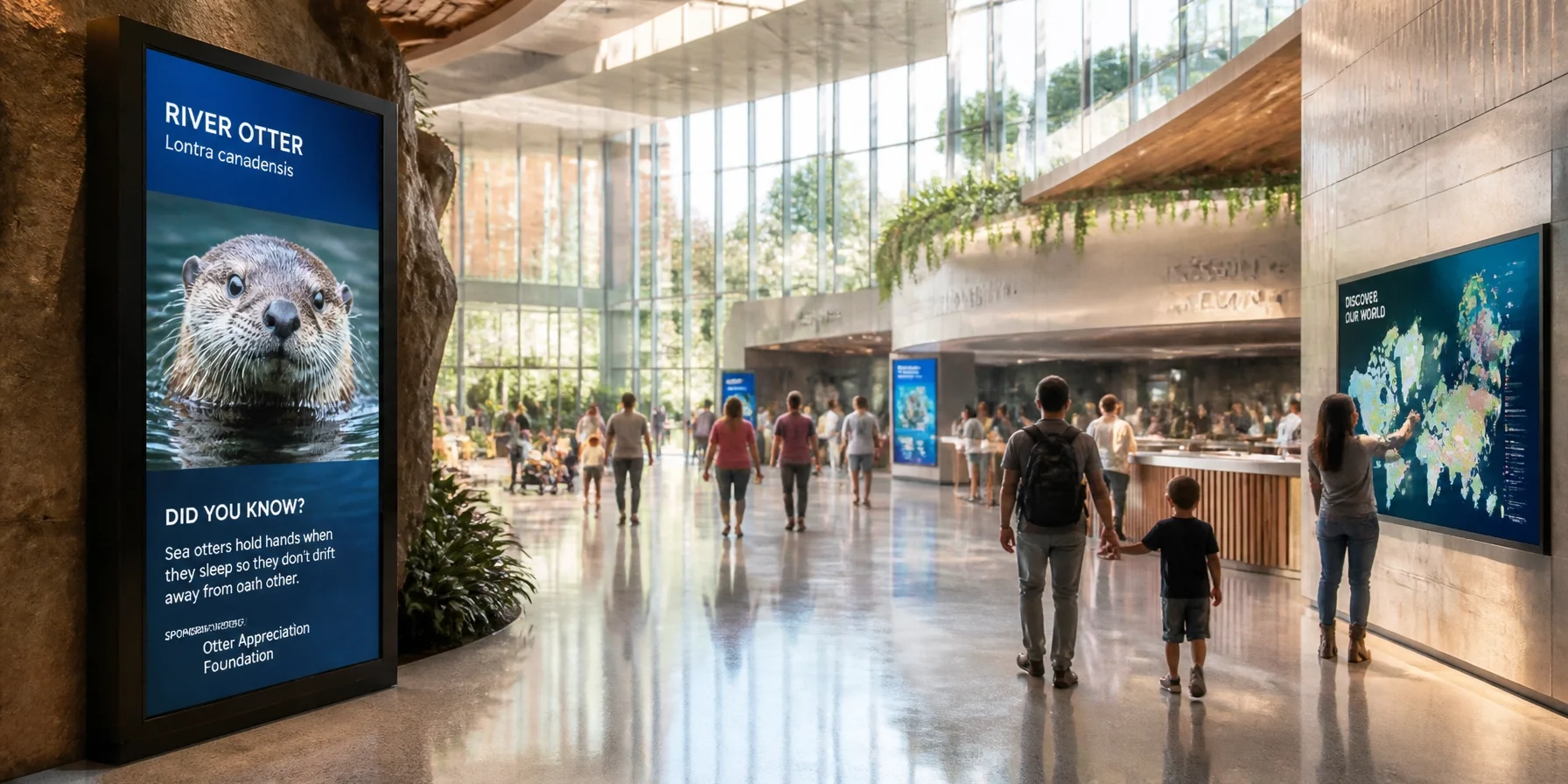
Smart signage solves this problem by replacing static information with centrally managed, real-time visual communication.
Screens can display:
- Live maps and walking directions
- Feeding times and keeper talks
- Exhibit closures or schedule changes
- Weather and safety notifications
- Restroom, dining, and retail locations
- Conservation campaigns
- Membership and donation opportunities
- Sponsored content and venue promotions
The system can be updated from a central content management platform, allowing marketing, education, guest services, and operations teams to work from the same information.
Lincoln Park Zoo: A practical wayfinding example
Lincoln Park Zoo in Chicago offers a useful example of how smart signage can work across indoor and outdoor environments.
Its digital signage program includes weather-resistant outdoor kiosks and high-brightness displays, along with indoor screens in the Searle Visitor Center. The outdoor equipment was selected to withstand rain, snow, humidity, sunlight, and frequent public use.
By distributing digital wayfinding beyond the entrance, the zoo gave visitors more opportunities to orient themselves throughout the grounds. Guests could check maps, locate amenities, and find exhibit information without returning to a single information desk.
That matters operationally. Better-distributed information can reduce entrance bottlenecks, lower repetitive questions for staff, and improve circulation during peak periods.
Read more about the project through Digital Signage Today’s Lincoln Park Zoo case study.
3. Interactive Displays Turn Education Into Participation
Static panels explain. Interactive displays invite visitors to investigate.
A touchscreen, motion-responsive wall, projection-mapped surface, or digital species tracker can turn a conservation message into an experience. Visitors can explore migration routes, simulate coral bleaching, compare animal sizes, follow veterinary care journeys, or make a virtual conservation pledge.
That shift is important because interactive education creates more opportunities for visitors to:
- Ask questions
- Make choices
- Compare outcomes
- Share the experience
- Return to complete another challenge
- Connect an animal encounter to a conservation action
The best interactive installations do not compete with live animals. They act as a bridge to them.
Technology should reveal what visitors cannot see with the naked eye: such as an animal’s migration pattern, underwater ecosystem, microscopic biology, or behind-the-scenes care: not distract from the living exhibit.

4. Projection Mapping and RFID Create Repeatable Experiences
Immersive media is expanding beyond traditional screens.
Projection mapping can turn walls, floors, buildings, and transitional spaces into programmable storytelling environments. RFID wearables can connect a visitor’s physical movement to digital content, badges, rewards, and follow-up communications.
Mandai Wildlife: A benchmark for immersive venue design
Mandai Wildlife Reserve’s Exploria in Singapore demonstrates how these technologies can work at scale.
The 10,000-square-meter indoor attraction combines projection, interactive media, responsive lighting, spatial audio, and multi-zone storytelling. Visitors move through themed environments inspired by prehistoric life, extreme climates, rainforests, microscopic ecosystems, and ocean habitats.
RFID wristbands connect guests to personalized digital avatars and interactive touchpoints. Visitors can unlock content, collect species badges, and track progress across the experience.
The business lesson is just as interesting as the creative one: the venue is designed as a programmable digital platform. Content can evolve over time, making seasonal updates, new campaigns, and repeat visits easier to support without rebuilding the entire attraction.
Explore Mandai’s official digital experiences for more examples.
5. 5G and AI Add Real-Time Intelligence
IoT creates data. AI helps interpret it.
With a reliable 5G or Wi-Fi 6 infrastructure, zoos and aquariums can move information quickly between sensors, displays, mobile devices, and operational dashboards.
Shoushan Zoo in Taiwan provides a strong example. Its smart zoo initiatives use 5G infrastructure, AI, augmented reality, and digital guide systems. An AI-powered system developed for the Taiwan black bear Bobby uses cameras and posture data to help identify the animal’s location and behavior in real time.
The officially described application focuses on visitor education and helping guests understand the bear’s activity. It also illustrates a broader opportunity: when animal behavior, environmental information, and visitor-facing content are connected, the venue can become more responsive and informative.
For directors and technology partners, the key takeaway is simple: connectivity is not merely a faster internet connection. It is the foundation for real-time visitor services, operational alerts, personalized content, and smarter decision-making.
See the Shoushan Zoo smart tourism information for additional background.
6. Smart Technology Creates New Sponsorship Inventory
Smart venues also create better opportunities for brands.
A static billboard delivers one message to everyone. A connected digital display network can deliver context-aware visual communication based on location, time, audience, weather, exhibit activity, or campaign goals.
Potential sponsorship placements include:
- Interactive conservation kiosks
- Feeding-time countdowns
- Digital wayfinding hubs
- Immersive exhibit zones
- Aquarium education walls
- Mobile or RFID-enabled challenges
- Sponsored animal-care stories
- Digital donation and membership stations
- Dining and retail displays
This gives brand managers and media buyers more than visibility. It creates measurable engagement.
Campaign reporting can include:
- Screen impressions
- Dwell time
- Interaction volume
- QR scans
- Website visits
- Membership conversions
- Donation activity
- Repeat participation
- Social sharing
This is where smart signage, digital marketing, and website development work together. A visitor might see a sponsored conservation story, scan a QR code, explore a campaign landing page, and receive a relevant follow-up invitation through the zoo’s CRM.
The result is a connected media journey: not a disconnected ad placement.
7. The Business Case: ROI Across the Venue
Zoo Media case snapshots illustrate the potential of integrated technology.
- A mid-size zoo reportedly achieved 3,592% ROI through an AI suite connecting CRM, phones, social media, and IoT systems.
- A regional aquarium unified fragmented systems into a central CRM and achieved a similar level of reported ROI.
- Digital signage and interactive systems can support membership, donations, sponsorships, retail, food service, and visitor retention at the same time.
The most important point is that ROI should not be measured only through ticket sales.
A more complete framework includes:
- Increased dwell time
- Higher membership renewals
- Greater donor participation
- Reduced staff workload
- Faster operational response
- Lower maintenance costs
- More efficient crowd management
- Stronger sponsor reporting
- Increased repeat visitation
- Improved conservation engagement

8. How Zoo and Aquarium Leaders Should Get Started
A smart venue transformation does not need to begin with a massive campus-wide project.
Start with a focused pilot.
A practical implementation checklist:
-
Audit the visitor journey
Identify bottlenecks, confusing routes, underused spaces, and high-value visitor moments. -
Choose one measurable goal
Examples include reducing entrance congestion, increasing membership conversions, or improving exhibit education. -
Select the right technology
Outdoor wayfinding may require high-brightness, weather-resistant displays. Humid aquarium areas may favor projection or touchless interaction over exposed touchscreens. -
Design around animal welfare
Consider sound, light, vibration, visitor density, and emergency shutoff requirements. Technology should support the mission, not overwhelm the animals. -
Build a content strategy
Hardware without refreshed content becomes expensive wallpaper. Establish ownership, update schedules, accessibility standards, and approval workflows. -
Connect the data
Integrate signage, websites, CRM, ticketing, membership, donations, and analytics wherever possible. -
Measure before and after
Track dwell time, crowd flow, engagement, conversions, visitor satisfaction, and operational savings.
The Smart Venue Is the Next Evolution of the Zoo Visit
IoT, smart signage, interactive displays, AI, 5G, and immersive media are not replacing the wonder of seeing a live animal.
They are helping visitors understand it.
When designed well, smart technology makes the guest journey smoother, gives staff better information, creates new sponsorship value, supports conservation education, and helps zoos and aquariums operate with greater precision.
That is the real opportunity: not turning a zoo into a theme park, but making it a more intelligent, accessible, educational, and mission-driven venue.
Ready to Build a Smarter Zoo or Aquarium?
Zoo Media helps zoos, aquariums, brands, and technology partners develop connected visitor experiences through IoT, smart signage, interactive displays, digital marketing, website development, and strategic visual communication.
To discuss a smart venue initiative:
- Website: www.dakdan.com
- AI Receptionist: +1 (323) 676-0621
- Leadership: Dan Kost, CEO
You can also explore Zoo Media’s related smart venue technology coverage.
Share This Article
Tags
#Motivation #Branding #Strategy #Marketing #AdvertisingAndMarketing #digitalmarketing #Innovation #Sports #ZooMedia #SmartVenues #IoT #DigitalSignage #InteractiveDisplays #VisualCommunication #WebsiteDevelopment #ConservationTechnology #AquariumTechnology #VisitorExperience