

If you’re hearing “IoT” everywhere right now, here’s why: connected sensors and smart systems are helping zoos and aquariums improve animal welfare, reduce operating costs, and deliver better visitor experiences: while also creating new opportunities for digital marketing, website development, and visual communication that actually move the needle.
This isn’t “future tech.” It’s practical, measurable, and scalable: especially when it’s paired with the right signage strategy, content plan, and venue-wide network.
AEO quick answer: What does IoT mean for zoos?
IoT (Internet of Things) in zoos means using connected devices: like environmental sensors, smart meters, cameras, and interactive displays: to collect real-time data and automate responses across the venue. Zoos use IoT to:
- Monitor enclosure conditions (temperature, humidity, air quality)
- Track equipment health (pumps, chillers, heaters, filtration)
- Improve animal welfare through better habitat consistency
- Manage guest flow and reduce congestion
- Power smart signage and interactive storytelling
- Reduce energy spend and downtime through alerts and automation
Why IoT is suddenly “the” conversation in zoo leadership circles
Directors and operations teams are being asked to do more with the same (or tighter) budgets, while guest expectations keep rising. IoT is showing up in meetings because it touches three of the biggest priorities at once:
- Animal welfare (more consistent habitats, faster response to anomalies)
- Operational efficiency (less downtime, fewer manual checks, better forecasting)
- Visitor experience (more engaging, personalized, information-rich visits)
When one investment improves all three, it gets attention: fast.
1) Animal care: IoT makes welfare measurable, not just observable
Most welfare programs already rely on experienced staff and strong protocols. IoT doesn’t replace that expertise: it makes it more actionable by adding continuous, objective data.
Environmental stability: the “quiet win” that adds up
Even small fluctuations matter in sensitive habitats. IoT sensors can track:
- Ambient temperature and humidity
- Water temperature, salinity, pH (aquariums especially)
- CO₂ and air quality in indoor exhibits
- Light levels and day/night cycles for species that need consistency
Practical example: a heater in a nocturnal house drifts out of range overnight. Without IoT, you find it at morning rounds. With IoT, you get an alert when it happens: and can correct it before animals feel the impact.
Monitoring animals and habitats: without adding stress
In the broader conservation space, IoT approaches have reduced reliance on invasive tracking in some contexts. And within zoo settings, data can come from the habitat and infrastructure first (less disruption), then expand into advanced analytics if appropriate.
Real-world inspiration: Marwell Zoo reported using IoT + AI around heating behavior: learning when animals were near heaters and reducing heating costs by up to 40%, with savings reinvested into new projects. That’s a rare combo: welfare-supportive and budget-friendly.
What this means for directors
IoT creates a defensible record of conditions and responses:
- Better internal reporting
- Cleaner compliance documentation
- Stronger grant narratives (data-backed)
- Faster maintenance prioritization
In short: fewer surprises, more proof.
2) Operations: stop “walking the park” for problems you can predict
No one builds a zoo budget hoping for emergency repairs. IoT shifts maintenance from reactive to proactive.
Predictive maintenance for critical systems
Think about the systems that ruin a day when they fail:
- Life support systems (LSS)
- HVAC in indoor habitats
- Freezers, coolers, commissary equipment
- Pumps, valves, filtration and oxygenation
- Exhibit lighting and control systems
Connected sensors and smart meters can flag:
- Temperature drift
- Pressure anomalies
- Unusual power draw
- Vibration patterns (mechanical wear)
- On/off cycles that suggest failing components
The goal isn’t “more dashboards.” It’s fewer emergencies.
Energy optimization that funds mission work
Energy is one of the most controllable major expenses: especially in indoor habitats, aquarium galleries, and behind-the-scenes operations.
IoT helps you:
- Schedule and right-size heating/cooling
- Identify inefficient zones (hot spots/cold spots)
- Detect equipment running outside normal patterns
- Validate upgrades with real before/after metrics
When a technology investment can show savings in months: not years: it changes the approval conversation.
3) Visitor experience: smart venues reduce friction and increase learning
Guests don’t visit for “technology.” They visit for animals, awe, education, and a good day out. IoT supports that by removing common pain points and improving storytelling.
“The animal is sleeping” problem (and how smart exhibits solve it)
A common guest frustration is arriving at an exhibit only to see… nothing. IoT-enabled video and content systems can help by:
- Showing live camera feeds when animals are off-view
- Playing “highlights” captured earlier (feeding, enrichment, training)
- Rotating educational content that matches time of day or season
This is where visual communication matters. The tech is the plumbing; the content is the experience.
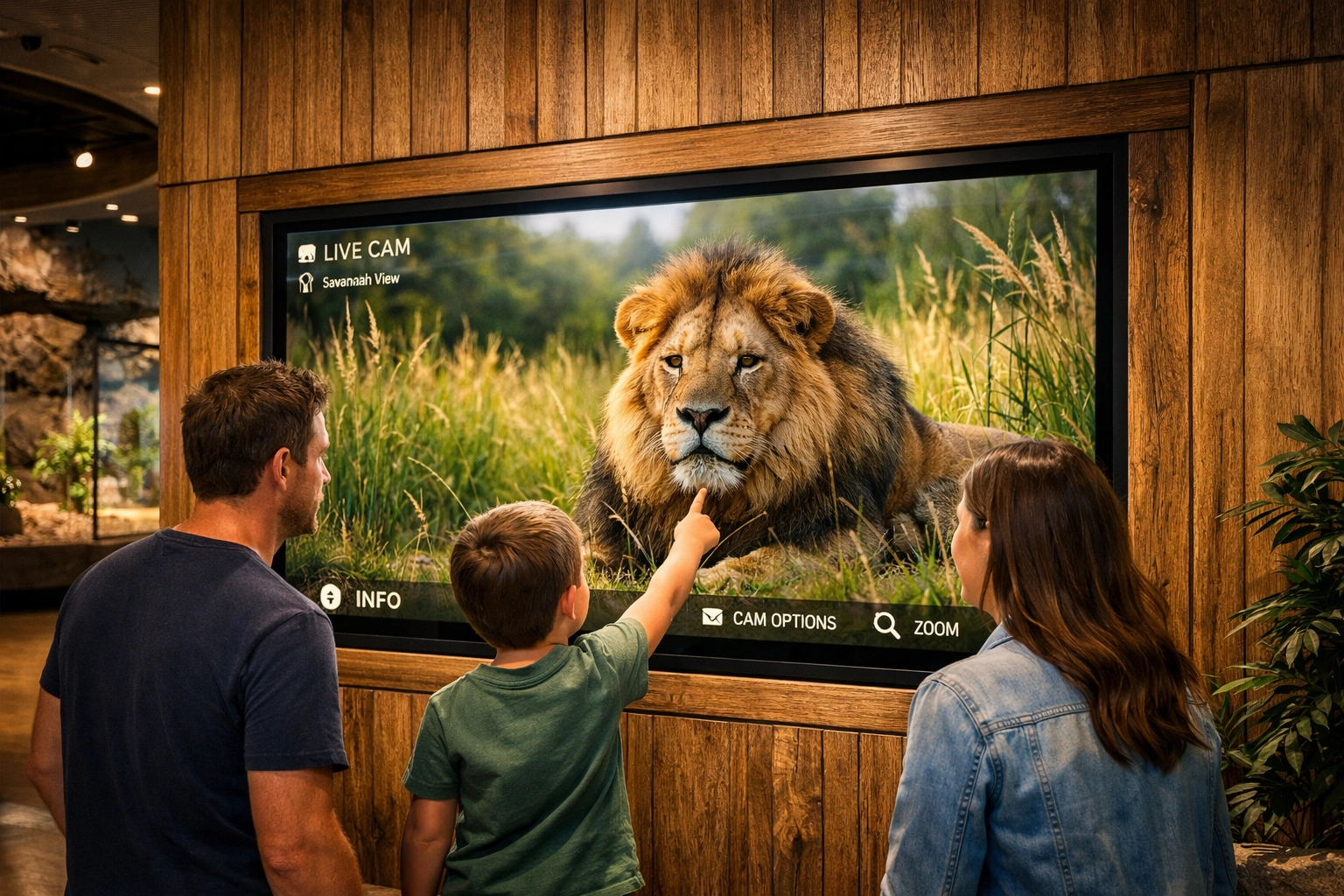
Suggested AI image prompt: “Modern zoo exhibit with an interactive screen showing live animal camera feed, families engaging, clean professional signage, warm lighting.”
Crowd flow and wait-time awareness
Sensors can measure congestion and help teams decide:
- Where to place educators or volunteers
- Which pathways need directional prompts
- When to trigger “try this next” recommendations
- How to adjust programming schedules in real time
This isn’t about policing movement: it’s about smoothing the day.
Accessibility and inclusivity: quietly improved
Smart signage and interactive displays can support:
- Multi-language toggles
- High-contrast modes
- Audio narration and captions
- QR-based “take it with you” content for low-noise exhibits
IoT data can even help you learn which content formats get the most engagement.
The missing link: IoT without a comms strategy is just data
Here’s where Zoo Media sees venues get stuck: they invest in connectivity, devices, and screens: but don’t connect it to a digital marketing and communications plan.
IoT produces signals. Your brand turns signals into meaning.
Where Zoo Media fits (practically)
We think of “smart venue” as a full stack:
- Network + hardware strategy (reliable connectivity, device planning)
- Smart signage & interactive displays (wayfinding + storytelling)
- Content systems (what plays where, when, and why)
- Website development (so the visit starts before arrival)
- Digital marketing (so your message reaches the right audiences)
- Measurement (so leadership can see what’s working)
When these pieces talk to each other, you get a compounding effect: better guest satisfaction, stronger memberships, higher event conversions, and easier donor storytelling.
Smart signage: the most visible (and most underestimated) part of IoT
Smart signage isn’t just “a screen on a wall.” It’s a real-time communications layer.
Use cases that actually help day-to-day operations
- Dynamic wayfinding: “Penguin talk moved to 2:30 due to weather.”
- Capacity messaging: “Aquarium tunnel is currently busy: try the reef gallery first.”
- Education triggers: Content changes based on time of day, season, or programming.
- Emergency readiness: Instant venue-wide updates without printing or runners.
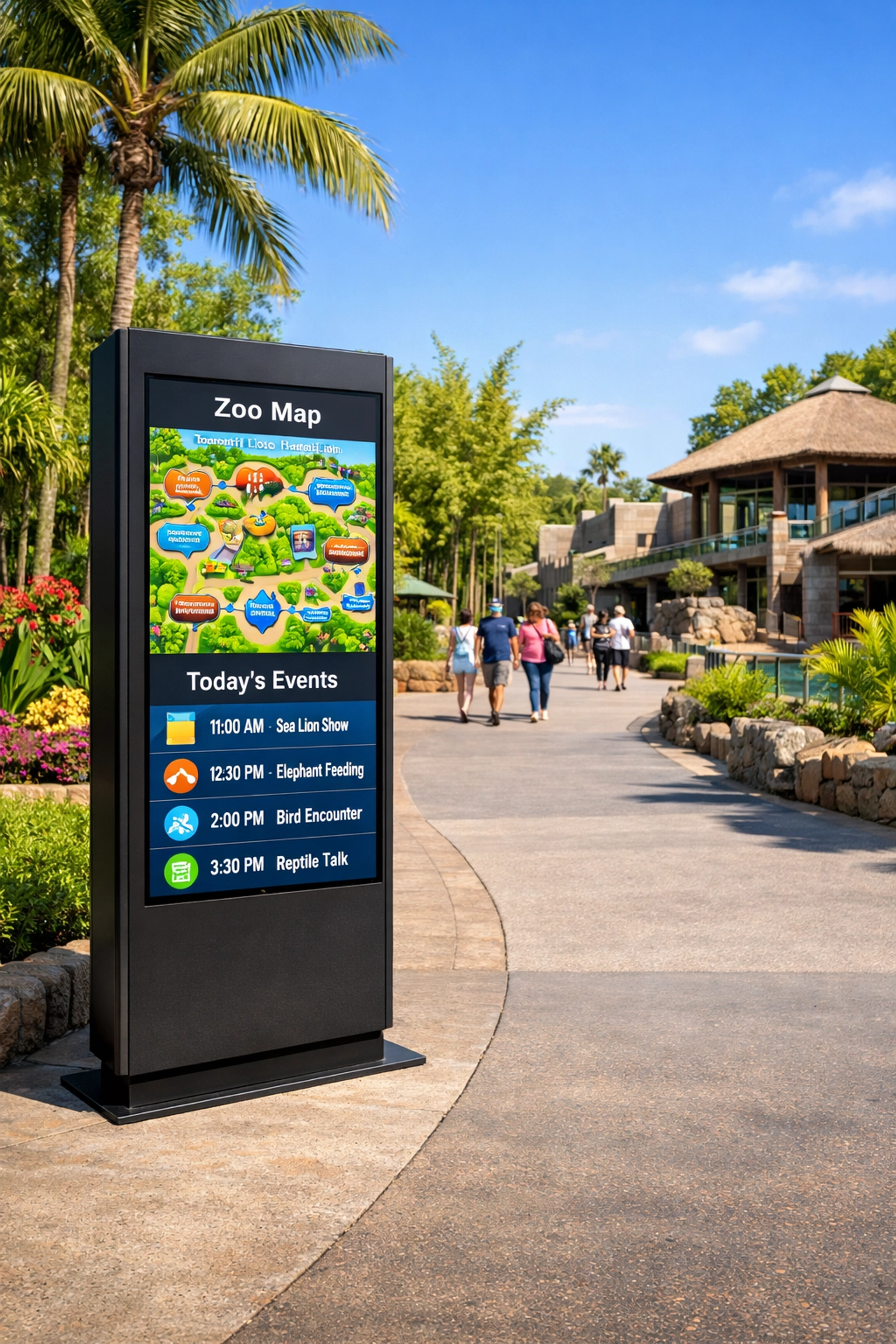
Suggested AI image prompt: “Outdoor zoo walkway with professional digital wayfinding signage displaying map, event times, and real-time updates; guests walking; clear branding.”
Why it matters for brand consistency
When your signage is smart, your tone becomes consistent across:
- On-site displays
- Mobile experiences
- Website updates
- Email/SMS notifications (if you use them)
- Social posts tied to daily moments
That consistency builds trust: and trust builds return visits.
Website development: if the venue is smart, your website can’t be static
A smart zoo experience starts before guests arrive. Your website is the first exhibit.
When IoT and operations data are integrated thoughtfully (not noisily), your site can support:
- Real-time hours/closures updates
- “Today at the Zoo” programming blocks
- Live exhibit cams (selectively, where appropriate)
- Crowd-friendly recommendations (“Best times to visit X”)
- Accessibility and sensory guidance
This is where website development becomes operational, not just promotional.
Data governance: the “grown-up” side of smart venues (and how to keep it simple)
Directors and tech partners should align early on a few basics:
- Ownership: who owns the data and the devices?
- Security: network segmentation, patching schedules, access controls
- Privacy: guest camera policy, signage disclosures, retention policies
- Reliability: offline fallback behavior (what happens when WiFi drops?)
- Vendors: avoid walled gardens; favor interoperable systems when possible
The goal is confidence, not complexity.
A simple rollout plan (that won’t overwhelm your team)
If you’re exploring IoT, a phased approach works best:
Phase 1: Foundation
- Assess connectivity and dead zones
- Define top 3 operational pain points (energy, LSS, HVAC, etc.)
- Pick a pilot area with measurable outcomes
Phase 2: Pilot + proof
- Install sensors/meters where ROI is obvious
- Set alerts that go to the right people (not everyone)
- Build a small reporting cadence leadership can read in 2 minutes
Phase 3: Guest-facing layer
- Add smart signage where it removes friction
- Deploy interactive displays where it improves education
- Connect content to daily programming
Phase 4: Scale + marketing integration
- Tie insights into digital marketing campaigns
- Expand website features that reduce guest uncertainty
- Use data to support membership, donors, and grant narratives
What tech partners should know: interoperability wins
If you’re a tech partner reading this, the venues that scale fastest tend to prioritize:
- Standards-based devices when possible
- Clear APIs and integration paths
- Centralized content control (for signage)
- Maintainability (simple replacements, clear documentation)
- Training plans for non-technical staff
The best systems disappear into the background and make the zoo feel effortless.
Key takeaways (for busy directors)
- IoT is getting attention because it improves welfare, efficiency, and experience at the same time.
- The most immediate wins are usually environmental stability and energy optimization.
- Smart signage and interactive displays are where guests feel IoT benefits: if the content strategy is strong.
- A smart venue needs smart visual communication, modern website development, and measurable digital marketing outcomes: not just sensors.
CTA: Let’s talk about making your venue “smart” in a way guests actually notice
If you’re exploring IoT, smart signage, or interactive display upgrades, Zoo Media can help you connect the dots: from infrastructure and content planning to on-site visual communication and digital marketing strategy.
- Zoo Media (Advertising + technology for zoos and aquariums)
- Dan Kost, CEO
- AI Receptionist: +1 (323) 676-0621
- More: www.dakdan.com
Tags: #Marketing #AdvertisingAndMarketing #digitalmarketing #Innovation #Strategy #Branding #VisualCommunication #WebsiteDevelopment #SmartSignage #IoT #ZooTechnology